AI Book Club: Co-Intelligence: Living and Working with AI by Ethan Mollick
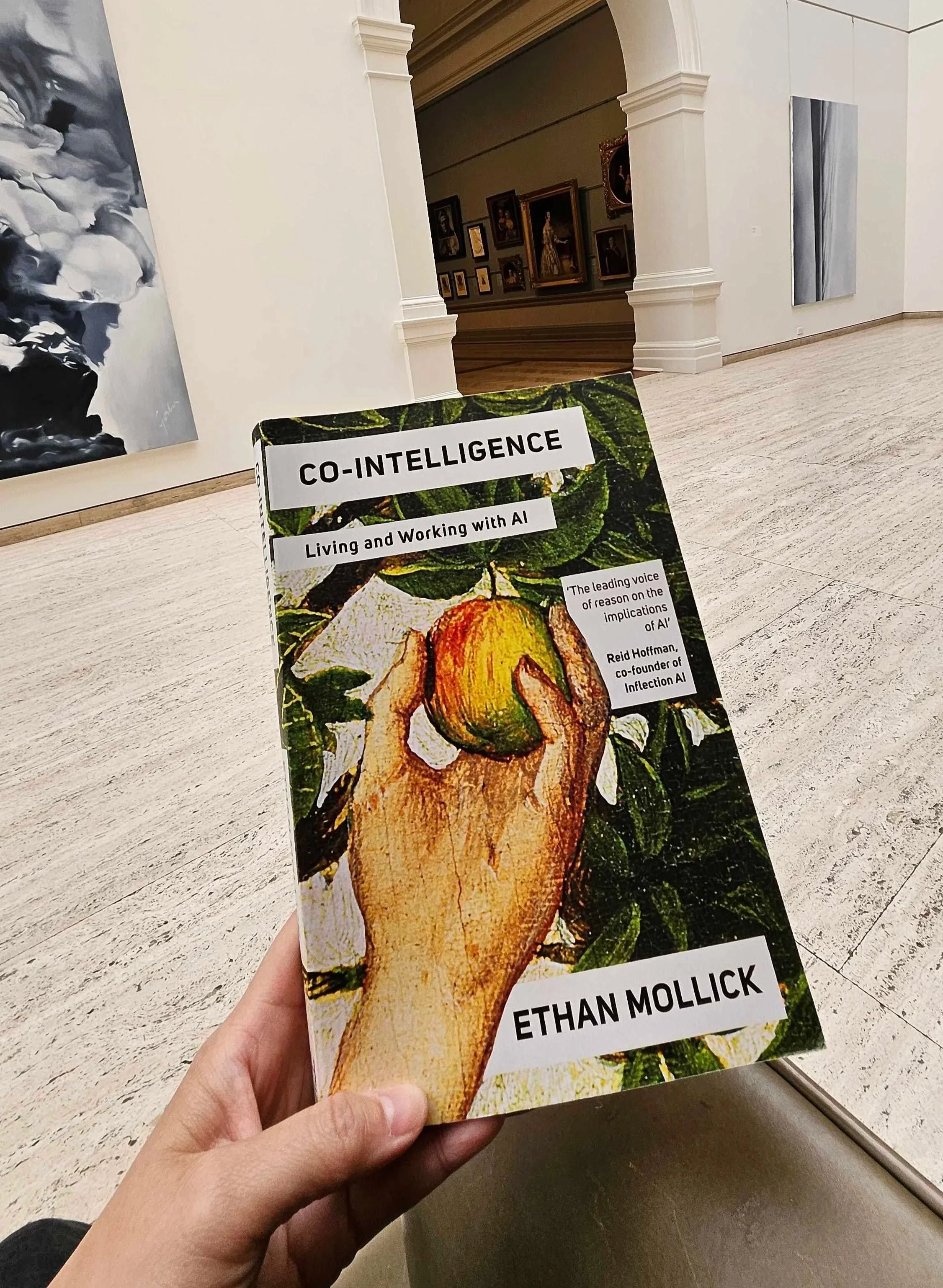
I devoured this book. It’s a perfect overarching overview into AI in general, lightly touching areas of its history, ethics and practical frameworks and models on how to integrate it into your life.
I think this book will hold up; it discusses approaches to AI in a more timeless manner that will likely mostly still make sense as AI gets more advanced.
The first big takeaway for me was his breakdown of the two types of AI users: the centaur vs the cyborg. Centaurs are users who have a clear list of human vs AI tasks, and it’s fairly separate. For instance, maybe you use AI for summarising reports but you the human do all the analysis and writing. Conversely, cyborgs are AI users that fully integrate AI across multiple steps. This might include brainstorming, drafting and proofreading in a LLM, where all the ideas and words are roughly yours but you’ve co-authored it with AI.
(I have also seen some technologists describe a third type of AI user: the sidecar user. This is where you test out AI by doing a task yourself, and then getting AI to separately do the task and compare notes. Great way to slowly see how to assign tasks, and slowly become a centaur.)
The second biggest takeaway from me was Mollick’s five principles of adopting AI:
Always invite AI to the table:
Experiment with using AI to help you with everything at least once, and / or try the same tasks again every few months.Be the human in the loop:
Most AI needs some human intervention or checks to ensure everything goes right.Even when that AI improves to the point that it can likely work with little human oversight, it’s still important to keep checking it.
Treat AI like a person:
While it is not recommended that you anthropromise your AI and fall in love (as per Spike Jonze’s Her), you should start thinking of your AI more as a thinking, feeling and very fallible person than a feeling-less robot.Think of AI as your lightning fast, confident and clever intern who is a bit lazy at times and likes to sometimes make stuff up.
Assume this is the worst AI that you will ever use:
It’s improving every single day, so don’t let frustrations and technological limits with it currently hold you back from being an adopter. Any issues you currently face are likely being fixed and will be non-issues, and shouldn’t be a deterrent from folding into your day-to-day.
Mollick also finishes the book with his three predictions of how humanity with exist with AI, ranging from terrifying (bordering into Terminator territory) vs peaceful and a non-issue.
Grab Co-Intelligence via Penguin Australia.